

Ecommerce Marketing in the UAE: Acquisition Cost and Channel Mix
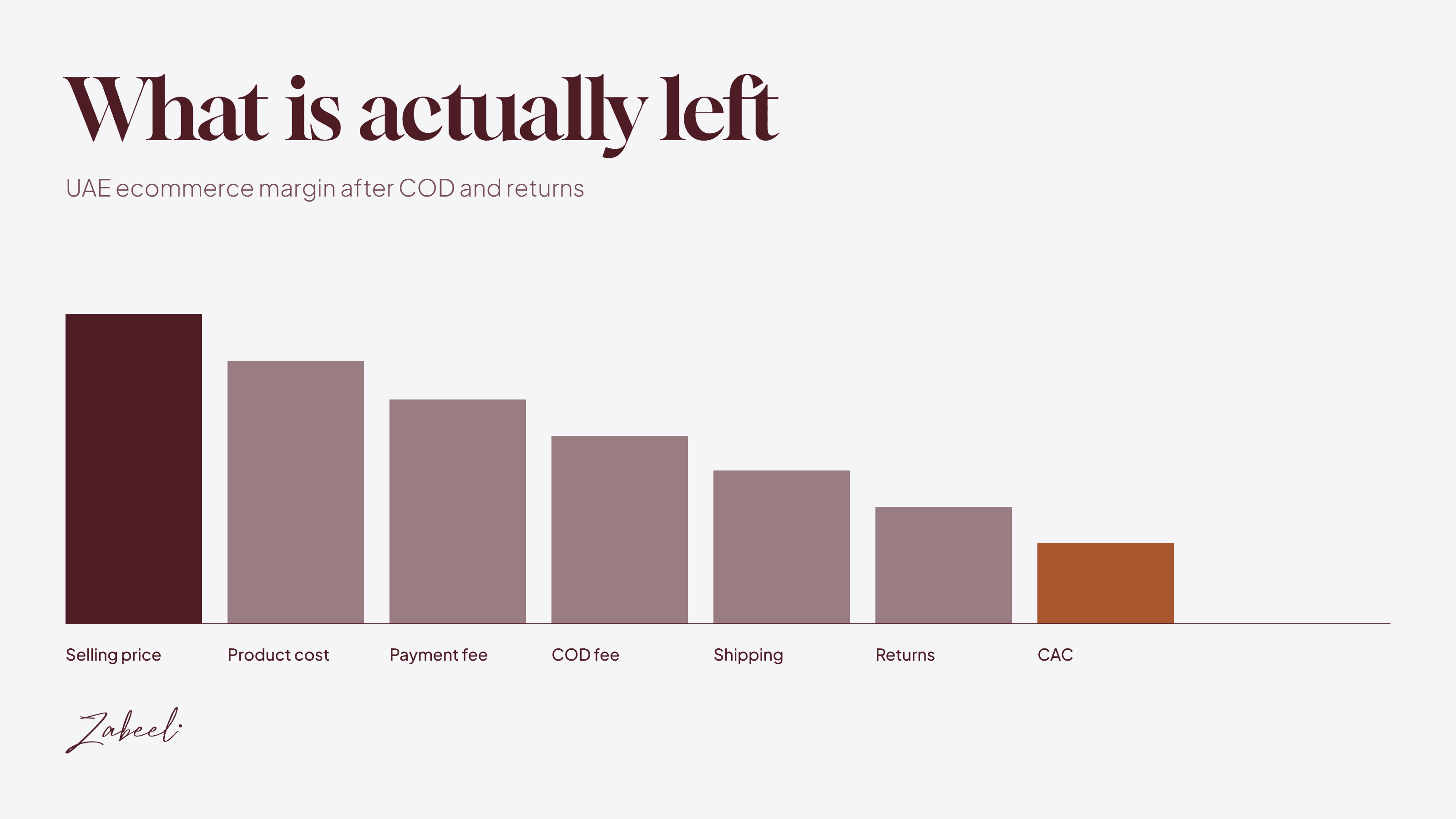
The UAE has excellent ecommerce conditions: high smartphone penetration, high disposable income, dense urban logistics and fast delivery expectations. It also has two features that quietly destroy margin models imported from other markets — a persistent cash-on-delivery habit and high return rates in fashion and footwear. If your acquisition maths ignores both, your reported CAC is fiction.
What is a good customer acquisition cost for UAE ecommerce?
There is no universal benchmark, and any article quoting one for “UAE ecommerce” is guessing. The only meaningful test is whether your contribution margin per order exceeds your acquisition cost per order, with enough headroom to cover fixed costs and repeat purchase uncertainty.
A working rule: your first-order contribution margin should cover CAC on its own for a low-repeat category, and may run at a controlled loss only where you have evidence of genuine repeat purchase behavior. In the UAE specifically, that evidence needs to account for the fact that COD orders and high-return categories have materially lower realized margin than the gross figure suggests.
How do you calculate CAC properly?
Most UAE stores calculate CAC as ad spend divided by orders. That understates the true figure, sometimes by a wide margin.
Include everything spent to acquire the customer:
Paid media spend across every platform, including any amount spent on retargeting existing visitors.
Agency or in-house management cost attributable to acquisition.
Creative production — photography, video, and the volume of ad creative UAE social platforms consume.
Influencer and affiliate fees, including product given away.
Discount and promo cost used to trigger the first order, which is acquisition spend by another name.
Marketplace commission where the marketplace acquired the customer, not you.
Then divide by new customers, not total orders. Blending repeat orders into the denominator is the most common way UAE stores flatter their own numbers.
The figure that actually governs your business is contribution margin per new customer:
Selling price, minus product cost, minus payment processing, minus COD handling fee, minus outbound shipping, minus expected return cost, minus CAC. If that number is negative and your repeat rate is unproven, growth makes you poorer.
Why does cash on delivery change your economics?
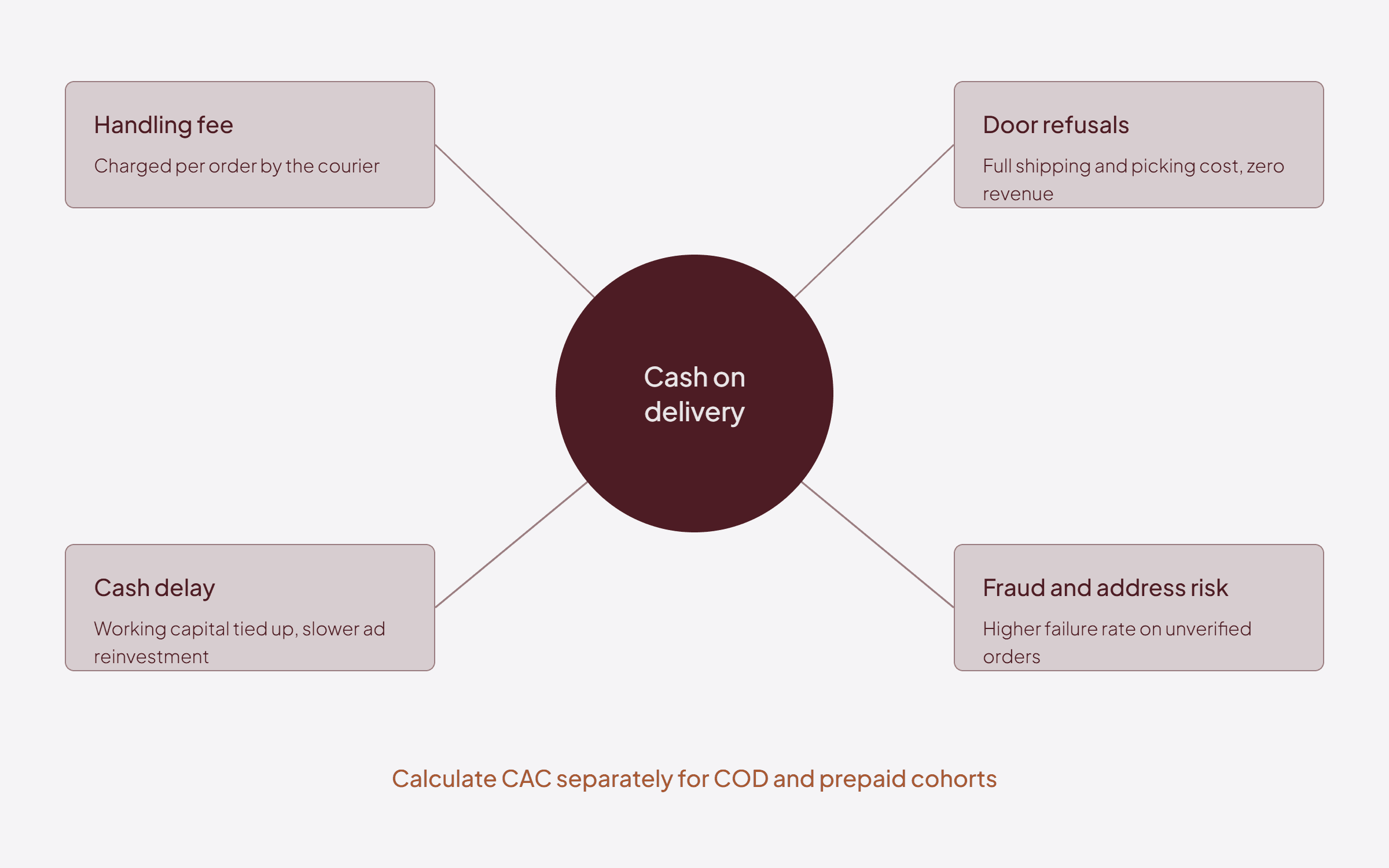
COD remains a meaningful share of UAE ecommerce orders, particularly outside the major card-comfortable segments, and it hits your margin in four separate places.
There is a COD handling fee per order charged by the courier. There is a higher refusal rate at the door, where the customer simply declines the parcel — you have then paid outbound shipping, return shipping and picking cost for zero revenue. There is a cash reconciliation delay, which is a working capital cost rather than a margin cost but constrains how fast you can reinvest in ads. And there is elevated fraud and address quality risk.
The practical responses are unglamorous and effective: incentivise prepayment with a small discount that costs less than your average COD loss, verify orders above a value threshold with a WhatsApp confirmation before dispatch, and calculate CAC separately for COD and prepaid cohorts. Many UAE stores discover their COD cohort is unprofitable while their blended number looks acceptable.
How do returns and RTO affect acquisition cost?
Returns and return-to-origin are the second silent margin drain, and they are concentrated in apparel, footwear and anything size-dependent.
Every returned order means you paid full CAC for zero net revenue, so your effective CAC on delivered-and-kept orders is higher than your reported CAC by the proportion of orders that come back. A store with a meaningful return rate is paying substantially more per retained customer than its dashboard shows.
Reducing this is a marketing problem as much as an operations problem. Better size guidance and fit information, more honest product photography, video on product pages, and clear delivery expectations all reduce returns. So does not advertising to audiences that convert cheaply but return heavily — which you will only discover if you segment return rate by acquisition channel.
What channel mix actually works for UAE ecommerce?
Channel | Strength | Watch for |
Meta (Instagram, Facebook) | Volume and creative-led discovery; strong UAE penetration | Rising costs; segment return rates by audience |
Google Shopping and Search | Highest purchase intent; captures existing demand | Limited by how much demand already exists |
TikTok | Discovery for younger audiences; low CPMs relative to Meta | Creative volume demand is high; attribution is messy |
Snapchat | Unusually strong Gulf penetration versus Western markets | Often overlooked; test before assuming irrelevance |
Influencer and UGC | High trust in this market; drives both reach and creative supply | UAE influencer licensing rules apply — verify compliance |
Marketplaces (Amazon.ae, Noon) | Immediate access to buying traffic | You rent the customer relationship; commission is real CAC |
Email and WhatsApp | Lowest-cost repeat revenue | Consent rules apply; build the list from day one |
Programmatic retargeting | Cheap incremental conversion at scale | Under-contested in this market |
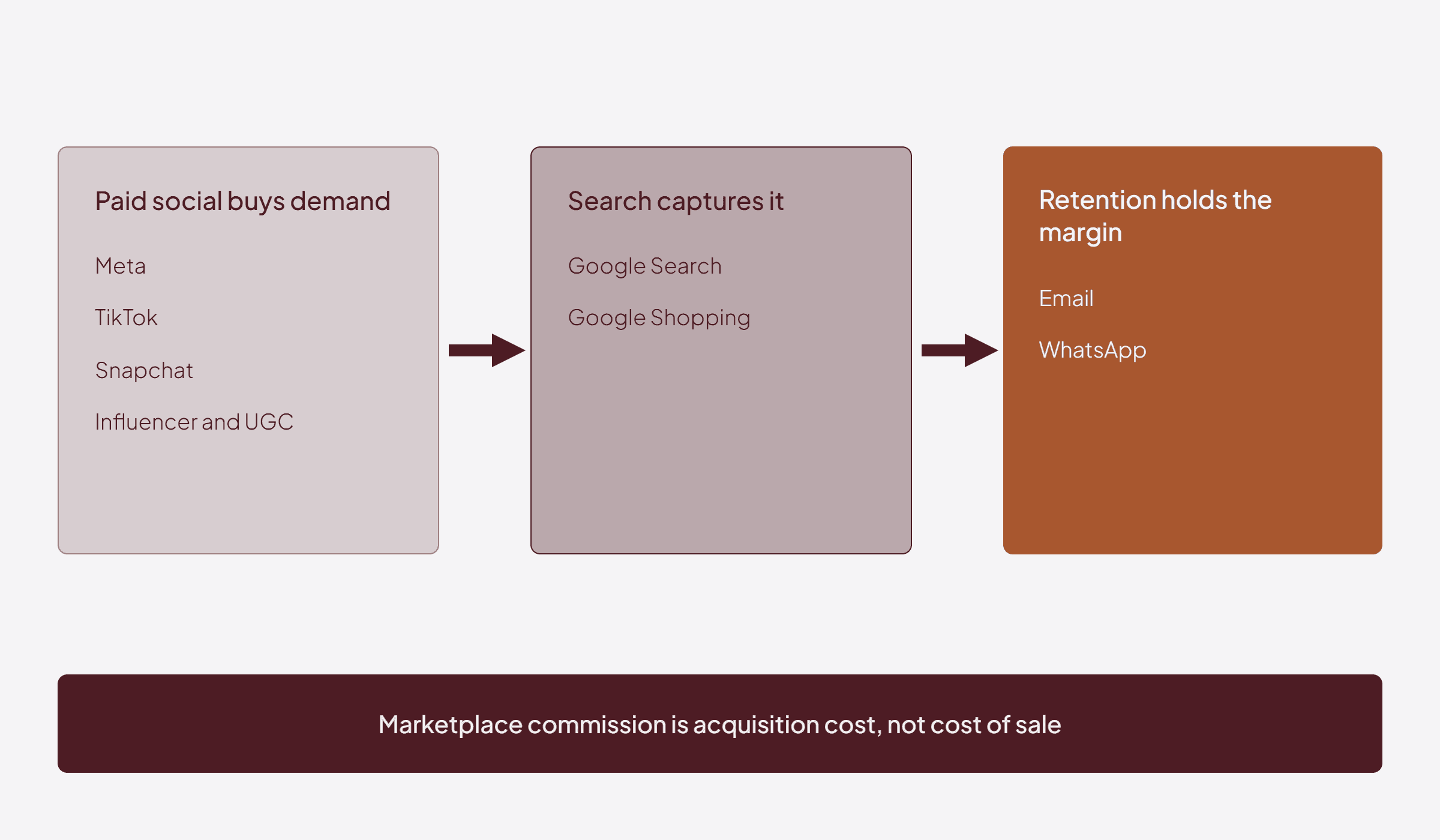
The strategic point: paid social buys demand, Google captures it, and email and WhatsApp are where your margin actually lives. Stores that spend everything on acquisition and nothing on retention run permanently on the edge of profitability, because they pay full CAC for every order forever.
Channel selection and geography interact. If you are running paid across the UAE, the targeting mechanics matter — our guide to PPC management across Abu Dhabi and Dubai covers the location settings that stop overseas traffic consuming budget.
Should you sell on marketplaces or your own store?
Both, but with clear eyes about what each one is for.
Marketplaces give you immediate access to buyers who are already shopping. The trade-off is that commission is a permanent acquisition cost, you learn very little about the customer, and you cannot build a retention channel. Treat marketplace revenue as valuable cash flow rather than as a business asset.
Your own store costs more per first order because you must generate the demand yourself, but you own the customer data, the email and WhatsApp list, the repeat purchase economics and the eventual enterprise value.
The sensible sequence for most UAE brands is to use marketplaces for cash flow and category validation while building direct-channel infrastructure — site, list, content and retention flows — in parallel. Anything that depends entirely on a marketplace is a channel, not a company.
How do you actually reduce CAC?
Reducing CAC is rarely about finding cheaper clicks. Four levers do most of the work.
Raise conversion rate. A meaningful improvement in site conversion reduces CAC proportionally, and it is usually cheaper to achieve than a comparable reduction in cost per click. Site speed, mobile checkout friction, payment options including COD, delivery clarity and trust signals are the usual constraints.
Raise average order value. Bundles, thresholds for free delivery, and cross-sell at checkout increase margin per acquisition without increasing spend.
Build the repeat channel. Email and WhatsApp flows — welcome, abandoned cart, post-purchase, replenishment — generate revenue at near-zero marginal acquisition cost. This is the single highest-return work available to most UAE stores and the most consistently neglected.
Improve creative volume and variety. In practice, creative is the main performance lever on Meta and TikTok. Accounts that refresh creative frequently sustain lower costs than accounts that optimise bidding endlessly against stale assets.
If you also sell through physical locations, local search visibility compounds with paid — see local SEO for multi-location businesses in Dubai.
Common mistakes to avoid
Calculating CAC on total orders rather than new customers
Excluding creative, agency fees and first-order discounts from CAC
Reporting one blended CAC across COD and prepaid cohorts
Ignoring return rate when comparing channel performance
Treating marketplace commission as a cost of sale rather than acquisition cost
Spending everything on acquisition and nothing on retention flows
Optimizing bids while running the same creative for months
Frequently asked questions
Q: What is a realistic CAC for a UAE ecommerce store?
A: It depends entirely on category, margin and repeat rate, and no single benchmark is meaningful. The test is whether contribution margin per new customer exceeds CAC with headroom for fixed costs, calculated separately for COD and prepaid orders.
Q: Is cash on delivery still necessary in the UAE?
A: For many categories it still materially increases conversion, so removing it outright can cost more revenue than it saves in fees. The better approach is to incentivise prepayment and verify high-value COD orders before dispatch.
Q: Should I sell on Noon and Amazon.ae or build my own store?
A: Use marketplaces for cash flow and validation, and build your own store for customer ownership and repeat economics. Relying solely on marketplaces means renting your customer base permanently.
Q: Which channel has the lowest CAC for UAE ecommerce?
A: Email and WhatsApp to existing customers, by a wide margin — but they only work once you have acquired customers elsewhere. Among acquisition channels, Google Search usually shows the lowest CAC and the lowest ceiling; paid social has a higher CAC and far more scale.
Q: How do UAE influencer rules affect ecommerce marketing?
A: Paid influencer activity in the UAE is subject to licensing requirements. Confirm current rules and that any creator you work with holds the necessary permit before running paid collaborations.
Key takeaways
Calculate CAC on new customers and include creative, fees and first-order discounts
COD hits margin four ways: handling fee, door refusals, cash delay and fraud risk
Segment CAC and return rate by channel and by COD versus prepaid
Marketplace commission is acquisition cost, not cost of sale
Retention flows on email and WhatsApp are where margin actually accumulates
Creative refresh rate matters more than bid optimisation on paid social
If you want an independent read on your unit economics before scaling spend, get in touch.
Read More
Ecommerce Marketing in the UAE: Acquisition Cost and Channel Mix

Local SEO for Multi-Location Businesses in Dubai

The Dubai Real Estate Marketing Playbook for Brokers and Developers

Dubai Marketing, Tech and Trade Event Calendar: Late 2026 into 2027
