

PPC Management in Abu Dhabi vs Dubai: What Actually Changes Between the Two Emirates

Most UAE advertisers run one campaign for the whole country, then wonder why their cost per lead is high and their lead quality is inconsistent. The usual cause is not bidding or creative. It is that Abu Dhabi and Dubai are two different markets sharing one currency and one ad account.
Is PPC management different in Abu Dhabi and Dubai?
Yes. The platforms and bidding mechanics are identical, but audience composition, language mix, competitive density and buying cycles differ enough that a single campaign underperforms in both emirates. Abu Dhabi skews toward government, energy and large-enterprise buying with longer approval cycles and a higher share of Arabic search. Dubai skews toward SMEs, expatriate consumers, tourism and trade, with more English search and far more advertiser competition.
The practical consequence: you should be running separate campaigns, not one campaign with two locations added.
Why does one UAE-wide campaign waste budget?
Because Google’s automated bidding optimises to a blended average. When you combine a lower-competition market with a higher-competition one in a single campaign, the algorithm cannot allocate distinctly. Three things go wrong at once.
Budget drifts to whichever emirate produces cheaper conversions, which is usually not the one with better lifetime value. Ad copy becomes generic, because it has to work for both audiences. And your reporting hides the truth, since a healthy blended cost per acquisition can conceal one emirate performing badly.
Separating campaigns costs you nothing except a little account structure work, and it gives you independent budget control, independent bid strategies and clean data.
How should you structure campaigns across both emirates?
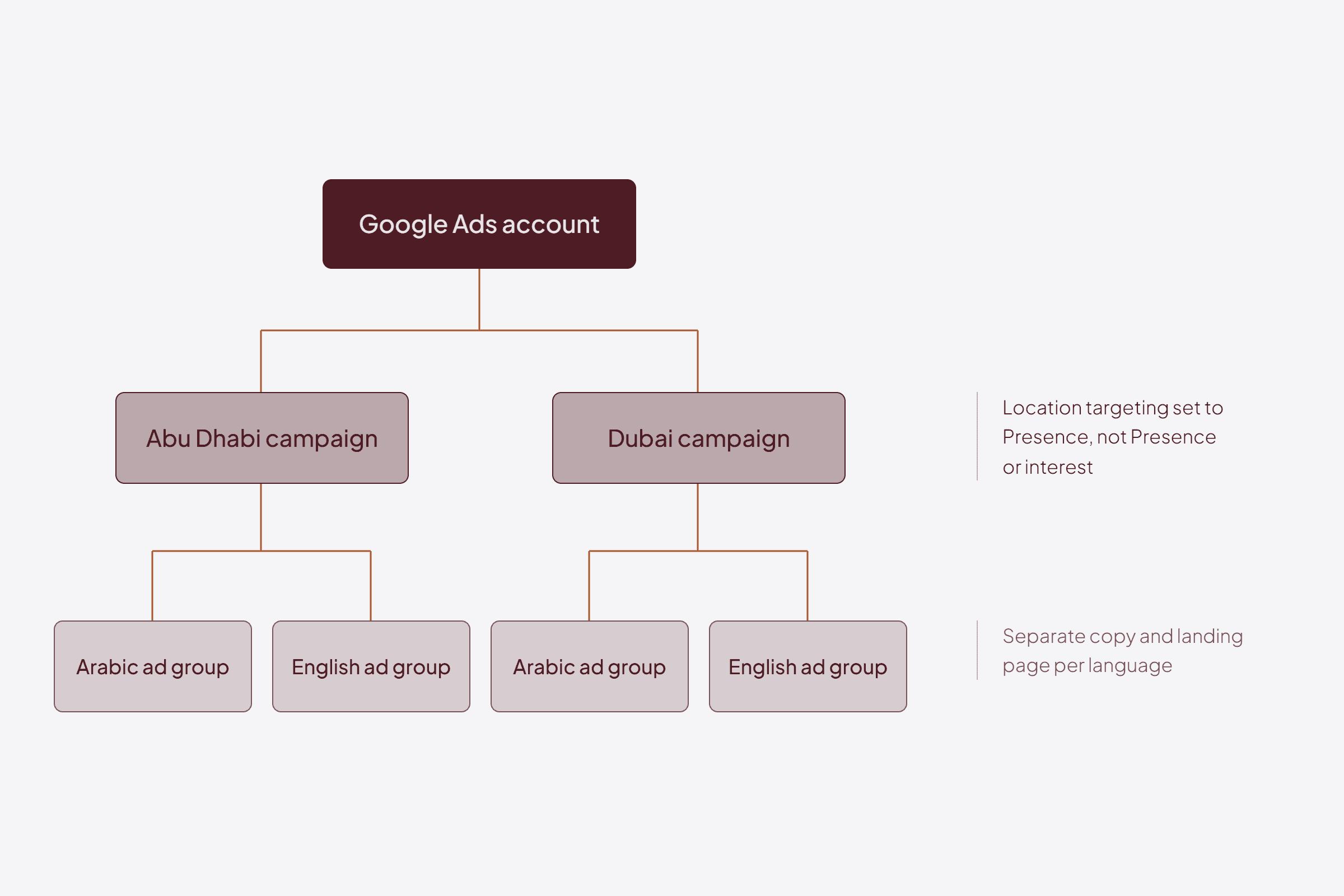
Use emirate-level campaign separation, then refine geography inside each campaign.
1. Split at campaign level by emirate. One campaign set for Abu Dhabi, one for Dubai. Never rely on location bid adjustments inside a shared campaign — automated bidding strategies ignore or override many of them.
Set location targeting to “Presence” rather than “Presence or interest.” The default setting shows your ads to people merely searching about the location, which in the UAE pulls in enormous volumes of overseas research traffic that will never convert.
Exclude the emirates you do not serve. Explicit exclusions matter more than inclusions, because UAE geography is dense and radius targeting bleeds across borders easily.
Refine within the emirate. In Dubai, target by community and business district rather than by city. In Abu Dhabi, distinguish the island, the mainland and the wider region, and treat Al Ain as its own market rather than an Abu Dhabi suburb.
Separate Arabic and English into their own campaigns or ad groups. Language should never be mixed with English in one ad group, because you lose the ability to control budget by language.
What differs between the two emirates in practice?
Factor | Dubai | Abu Dhabi |
Advertiser competition | High — most UAE agencies and SMEs bid here | Noticeably lower on equivalent commercial terms |
Typical cost per click | Higher on commercial intent terms | Generally lower for the same service category |
Dominant buyer type | SMEs, consumers, expatriates, tourism, trade | Government, semi-government, energy, large enterprise |
Sales cycle | Shorter, more self-serve | Longer, more procurement and tender-driven |
Arabic search share | Lower, English-dominant | Higher — Arabic ad copy matters more |
Geo-targeting approach | Community and district level | Island, mainland and Al Ain as distinct markets |
Useful conversion action | Form fill, WhatsApp, call | Enquiry form, document download, meeting request |
Treat the cost figures as directional. Verify current benchmarks for your own category in Google’s Keyword Planner before setting budgets, since competitive density shifts quickly in this market.
How should you split budget between Abu Dhabi and Dubai?
Do not split by population or by instinct. Split by where your closed revenue actually comes from, and let the ratio move.
Start with a deliberate test period, weighted toward whichever emirate already produces your revenue, and give the second emirate enough budget to generate statistically meaningful data rather than a token allocation. A campaign that receives too little budget to accumulate conversions will look like a failure when it is simply starved.
Then judge on closed revenue, not leads. Abu Dhabi often produces fewer, slower, larger deals; Dubai often produces more, faster, smaller ones. A cost per lead comparison will mislead you badly here. This is the single most common budgeting error we see in UAE accounts.
What about language targeting and Arabic ad copy?
Arabic is not a translation task, it is a separate campaign with its own keywords, ad copy, landing page and budget.
Machine-translated Arabic ad copy performs poorly and damages credibility, particularly for enterprise and government buyers in Abu Dhabi. If you cannot commit to properly written Arabic copy and an Arabic landing page, it is better to run English-only than to run weak Arabic. Where Arabic is done properly, competition is usually thinner and cost per click lower — which is precisely why it is worth doing.
The same logic applies to your organic strategy. If you want the search side to compound alongside paid, our guide to local SEO for multi-location businesses in Dubai covers how to structure branch-level pages and Google Business Profiles so paid and organic reinforce each other.
Which platforms matter beyond Google Ads?
Google Search carries the highest commercial intent, but it should rarely be your only channel in the UAE.
Meta (Instagram and Facebook) — strong for consumer, retail, property and food and beverage. Instagram penetration in the UAE is high across both emirates.
LinkedIn — the most reliable paid channel for Abu Dhabi enterprise and government-adjacent B2B, despite a high cost per click.
TikTok and Snapchat — meaningful reach with younger UAE audiences; Snapchat in particular retains unusually strong penetration in the Gulf compared with Western markets.
Programmatic display — useful for awareness and retargeting at scale, and notably under-contested in this market.
YouTube — effective for property and high-consideration purchases where the buyer needs to see the asset.
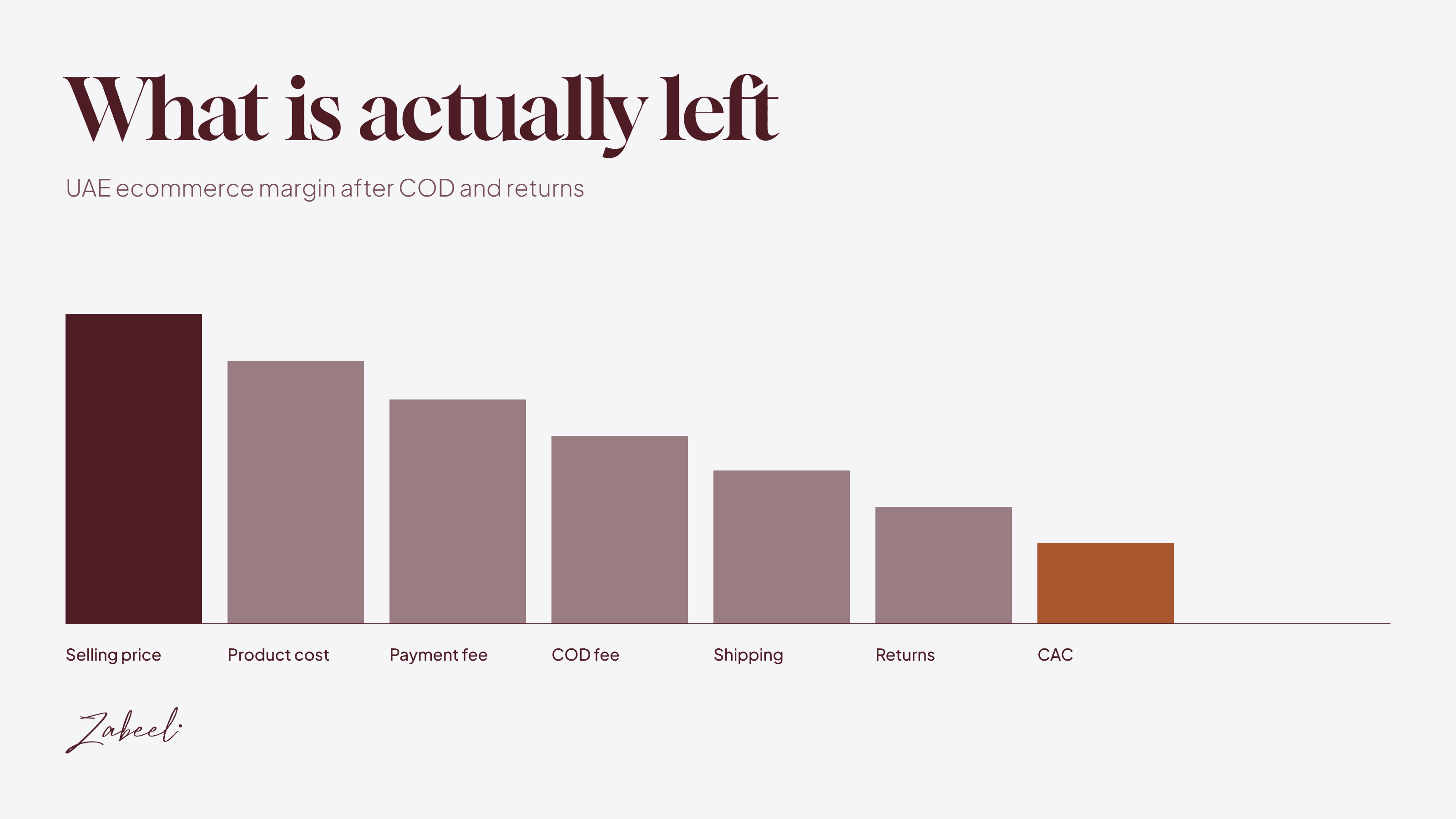
For ecommerce advertisers, channel choice is inseparable from unit economics. Our breakdown of acquisition cost and channel mix for UAE ecommerce works through how cash on delivery and return rates change which channels are actually profitable.
What does PPC management cost in the UAE?
Agency pricing in the UAE generally follows one of three models, and the differences matter more than the headline number.
Percentage of ad spend is common, typically applied to media budgets above a threshold. It aligns the agency with scale but not necessarily with efficiency, since the agency earns more as you spend more.
Flat monthly retainer is the most predictable and the most common for SMEs. Ask exactly what is included: campaign management only, or landing pages, creative, call tracking and reporting.
Performance or hybrid models tie part of the fee to results. These work only where conversion tracking is genuinely reliable and both parties agree on what a qualified lead is.
Whichever model you choose, insist on three things in writing: you own the Google Ads account, you own the conversion tracking, and you receive raw platform access rather than only a dashboard. Agencies that resist this are protecting switching costs, not your data.
[VERIFY: insert current AED retainer ranges from your own pricing or a recent market survey, with source. Do not publish unsourced figures.]
How do you measure success across two emirates?
Report every metric split by emirate, from the first day. Blended UAE numbers are the enemy of good decisions.
At minimum, track cost per qualified lead, lead-to-opportunity rate, closed revenue and average deal size separately for Abu Dhabi and Dubai. Import offline conversions from your CRM so the platforms optimize toward revenue rather than form fills — this single change usually does more for UAE account performance than any bidding adjustment.
Set your attribution window to match your real sales cycle. A 30-day window will systematically understate Abu Dhabi enterprise performance if those deals take three months to close.
Common mistakes to avoid
Running one UAE-wide campaign and relying on location bid adjustments
Leaving location targeting on “Presence or interest,” which imports overseas research traffic
Comparing emirates on cost per lead rather than closed revenue
Machine-translating ad copy into Arabic
Sending both emirates to the same generic landing page
Letting the agency own the ad account and conversion tracking
Judging a starved second-emirate campaign before it has enough conversion data
Frequently asked questions
Q: Is PPC cheaper in Abu Dhabi than Dubai?
A: Usually yes, on equivalent commercial terms, because advertiser density is lower. But cheaper clicks do not automatically mean cheaper customers. Abu Dhabi’s longer sales cycles can raise the true cost per closed deal, so compare on revenue rather than clicks.
Q: Should I run separate campaigns for Abu Dhabi and Dubai?
A: Yes. Separate campaigns give you independent budgets, independent bid strategies, emirate-specific ad copy and clean reporting. Location bid adjustments inside a single shared campaign are not a substitute, because several automated bidding strategies override them.
Q: Do I need Arabic ads to succeed in the UAE?
A: Not always, but Arabic is close to essential for Abu Dhabi government and enterprise audiences, and it is generally less competitive. Only run Arabic if you can produce properly written copy and a matching Arabic landing page.
Q: How long before UAE PPC campaigns produce reliable data?
A: Plan on a full sales cycle plus a learning period, and resist judging performance on the first few weeks. Enterprise campaigns in Abu Dhabi may need a quarter or more before closed-revenue data is meaningful.
Q: Can one agency manage both emirates effectively?
A:Yes, provided they structure the account by emirate, write separate copy, and report separately. The warning sign is an agency that presents only blended UAE numbers.
Key takeaways
Abu Dhabi and Dubai are different markets; separate them at campaign level, not with bid adjustments
Set location targeting to “Presence” to avoid overseas research traffic
Split budget by closed revenue, not population or cost per lead
Arabic is a separate campaign with its own copy and landing page, not a translation
Import CRM conversions so bidding optimises to revenue
Always report the two emirates separately
Working out how to divide budget across emirates, channels and languages is genuinely difficult, and the answer depends on your sales cycle and margin. If you would like a second opinion on your current account structure, get in touch.
Read More
Ecommerce Marketing in the UAE: Acquisition Cost and Channel Mix

Local SEO for Multi-Location Businesses in Dubai

The Dubai Real Estate Marketing Playbook for Brokers and Developers

Dubai Marketing, Tech and Trade Event Calendar: Late 2026 into 2027