

Local SEO for Multi-Location Businesses in Dubai

Dubai punishes sloppy local SEO in a specific way. The city has no conventional postcode system, community names overlap and get abbreviated inconsistently, most businesses trade under a name that differs from their trade licence, and a large share of the population searches in a second language. Every one of those is a consistency problem, and local search runs on consistency.
What is local SEO, and why is Dubai different?
Local SEO is the practice of ranking in the map pack and local results when someone searches with implicit or explicit local intent — “seo companies near me,” “dentist in JLT,” “car service Al Quoz.” It is driven by three factors: the relevance of your listing, its distance from the searcher, and its prominence.
Dubai introduces four complications that do not exist in most markets:
No postcodes. Addresses rely on building name, community and Makani numbers, which means address strings are entered inconsistently across the web.
Overlapping and abbreviated community names. JLT and Jumeirah Lake Towers, DIFC and Dubai International Financial Centre, Business Bay and Downtown boundaries in the public mind — all of these fragment your signals.
Trade licence name versus brand name. Your licence may read something quite different from your signage, and mismatches between the two across directories dilute your entity.
Bilingual search. A meaningful share of your market searches in Arabic, and most competitors have not built for it.
How should you structure Google Business Profiles for multiple branches?
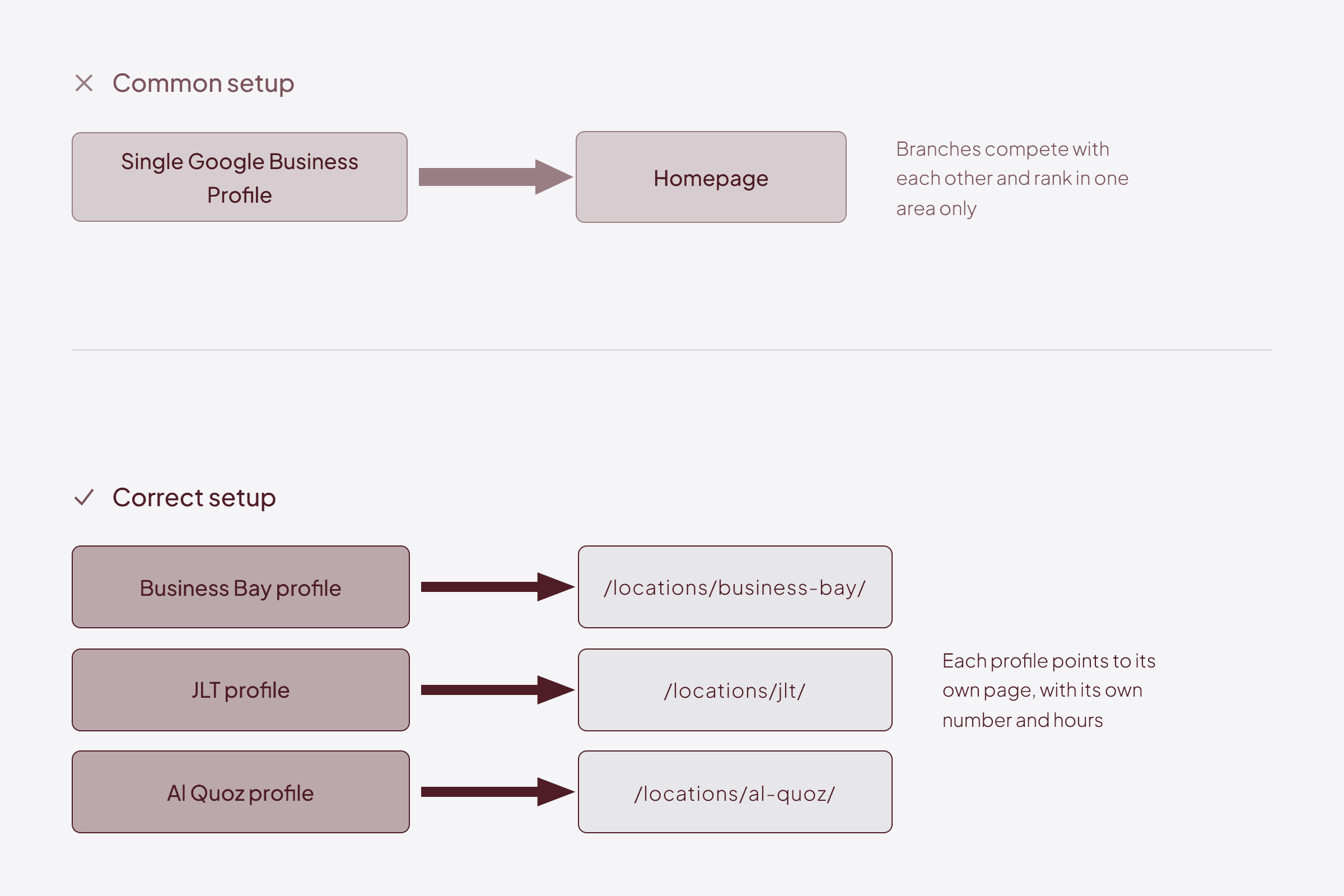
One profile per physical location where staff are present during stated hours. Not one profile for the brand, and not a profile for an address you merely hold a licence at.
1. Create and verify a separate profile for each branch. Verification in the UAE frequently requires trade licence documentation, so have it ready and ensure the name on it aligns with the profile name.
2. Use identical brand naming across every profile, with the location appended only if the platform’s guidelines and your signage support it. Do not stuff keywords into the business name — it is against Google’s guidelines and it is one of the most commonly reported violations in this market.
3. Set the primary category identically across branches, then use secondary categories to reflect genuine per-branch service differences.
4. Give each profile its own local phone number where possible. A single central number across all branches weakens the distinctness of each listing.
5. Point each profile at its own location page, not at the homepage. This is the single most impactful and most frequently skipped step.
6. Define service areas honestly. Overstating a service area to cover all of Dubai dilutes relevance rather than expanding it.
7. Keep hours accurate, including Ramadan hours and public holidays. Hour accuracy affects both ranking and the volume of negative reviews you receive.
Consider a Business Profile manager account structure with location groups if you run more than a handful of branches, so permissions and bulk updates stay manageable.
What should each location page contain?
The failure mode here is templated pages where only the address changes. Google treats those as near-duplicates and often chooses to rank none of them.
Each location page needs genuinely distinct content:
The branch address written in a single canonical format, with the building name and community
A Makani number or clear directions, plus an embedded map
That branch’s own phone number and its own contact form or WhatsApp link
Hours for that branch specifically
The team based at that location, named, with photographs
The services genuinely offered at that branch, which may be a subset of your full range
Parking, metro proximity and access notes, which UAE customers actively search for
Reviews or testimonials from customers of that branch
LocalBusiness structured data with that branch’s details
Write at least a few hundred words of unique commentary per page about that specific area and the customers it serves. If you cannot write anything genuinely different about a branch, that is a signal the branch may not warrant its own page.
How do you handle NAP consistency in the UAE?
Name, address and phone consistency is the foundation, and Dubai makes it unusually difficult.
Decide on one canonical format for your address and enforce it everywhere without exception — the same building name, the same community spelling, the same abbreviation choices, the same phone number format including the country code. Write it down in a document, give it to everyone who creates listings, and audit it quarterly.
Specific UAE decisions to make deliberately: whether you write JLT or Jumeirah Lake Towers, whether you include the Makani number, whether you use the full trade license name or the brand name, whether phone numbers appear as +971 4 XXX XXXX or 04 XXX XXXX, and whether you maintain Arabic-language name and address variants. Inconsistency on any of these fragments your entity across the web.
Which local citations matter in the UAE?
Priorities quality and relevance over volume. A hundred low-grade directory listings do less than a dozen credible, correctly-formatted ones.
Start with Google Business Profile, Apple Business Connect and Bing Places. Add the major UAE and regional business directories, your industry-specific platforms — property portals, clinic directories, food delivery aggregators, whichever apply to you — and your Dubai Chamber or free zone directory entry where you hold membership. Ensure your own website’s contact and location pages agree with all of them.
Audit for duplicates aggressively. Duplicate profiles for the same branch, often created years ago by a former employee or an aggregator, are a common cause of suppressed rankings in this market.
How do reviews work for a multi-branch business?
Reviews accrue to the individual profile, not to the brand, so a business with one excellent branch and four unreviewed ones will only rank well in one area.
Build a review request process that runs per branch and attributes correctly, at the point where the customer is most satisfied. Respond to every review, positive and negative, from the branch profile. Where you have Arabic-speaking customers, respond in the language the review was written in. And never incentivize reviews with discounts or gifts — it violates platform policy and UAE consumer protection expectations, and it is easy to detect.
Watch for review velocity that looks unnatural. A branch that receives no reviews for a year and then thirty in a week attracts filtering, not ranking.
How do you avoid duplicate content across location pages?
Three practical safeguards.
Write area-specific content, not templated content. The unique portion should be substantive, not a swapped city name in an otherwise identical paragraph.
Do not create pages for locations you do not physically occupy. Doorway pages targeting every Dubai community you would like to serve are explicitly against Google’s guidelines and are a common reason for local ranking collapse.
Use a clear URL structure and internal linking. A pattern like /locations/business-bay/ with a parent locations hub, linked from your main navigation and from the relevant service pages, gives Google an unambiguous map of your branches.
If you run a multi-office brokerage or clinic group, the same structural logic applies to your service pages. Our Dubai real estate marketing playbook covers how brokerages should handle branch-level presence alongside portal listings.
How do you track local performance by branch?
Blended reporting hides branch problems. Track each location separately.
Use Google Business Profile performance data per profile for discovery searches, calls, direction requests and website clicks. Add UTM parameters to the website link on each profile so branch traffic is distinguishable in analytics. Set up call tracking numbers per branch, forwarding to the branch line. Segment Search Console data by the location page URL. And track map pack ranking by branch using a rank tracker that supports geo-specific checks, because ranking varies street by street in a city this dense.
The metric that matters most is direction requests and calls per branch, not overall site traffic. Local SEO succeeds when it produces physical visits.
Where you are also running paid campaigns, geo-targeting settings determine whether your paid and organic efforts reinforce or cannibalize each other — see PPC management across Abu Dhabi and Dubai. For retail businesses with both stores and an online channel, UAE ecommerce acquisition cost and channel mix covers how to attribute across the two.
Common mistakes to avoid
• One Google Business Profile for a business with several branches
• Pointing every profile at the homepage rather than its own location page
• Keyword-stuffing the business name in the profile
• Templated location pages where only the address changes
• Creating pages for communities you do not have a physical presence in
• Inconsistent address formats and abbreviations across directories
• A single central phone number across all branches
• Incentivizing reviews, or requesting them in unnatural bursts
• Reporting local performance at brand level rather than per branch
Frequently asked questions
Q: How many Google Business Profiles should a multi-branch Dubai business have?
A: One per physical location that is staffed during its stated hours. Do not create profiles for addresses you do not occupy, and do not consolidate real branches into a single profile.
Q: Do I need separate location pages for each Dubai branch?
A: Yes, and each must contain genuinely distinct content — that branch’s team, services, hours, contact route, access notes and reviews — plus Local Business structured data. Templated pages with only the address changed tend to rank poorly.
Q:Does Arabic content help local SEO in Dubai?
A: It can help significantly, because a meaningful share of local searches are in Arabic and comparatively few competitors have built Arabic pages. It requires properly written Arabic rather than machine translation, and consistent Arabic name and address variants.
Q: How long does local SEO take to work in Dubai?
A: Profile and citation fixes can shift map pack visibility within weeks. Building enough prominence to compete in dense, high-competition communities generally takes months of consistent review generation, content and links.
Q: Why do my branches rank in some areas and not others?
A: Proximity is a strong ranking factor, so results vary by the searcher’s exact location. Beyond that, uneven review volume, missing or duplicated profiles, and location pages of inconsistent quality are the usual causes.
Key takeaways
One verified profile per staffed physical branch, each pointing to its own location page
Choose one canonical address format for Dubai’s postcode-free addressing and enforce it everywhere
Location pages need genuinely unique content, not a templated swap
Reviews accrue per branch, so the request process must run per branch
Never build pages for communities you do not physically occupy
Measure calls and direction requests per branch, not blended site traffic
If you would like an audit of how your branches currently appear across profiles, citations and location pages, get in touch.
Read More
Ecommerce Marketing in the UAE: Acquisition Cost and Channel Mix
Local SEO for Multi-Location Businesses in Dubai

The Dubai Real Estate Marketing Playbook for Brokers and Developers

Dubai Marketing, Tech and Trade Event Calendar: Late 2026 into 2027
